Published on International Tiger Day from the edge of Chitwan National Park
I didn’t know exactly what I was walking into when I boarded a plane to Nepal.
I knew the technical goals: conduct field research, complete an internship, and gather data on human-wildlife conflict. But I didn’t fully grasp how much the experience would shift the way I see the world, and myself in it.
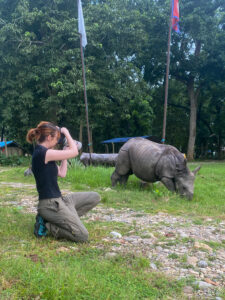
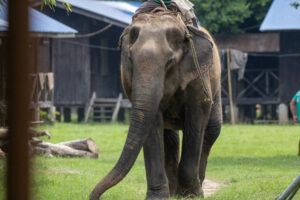
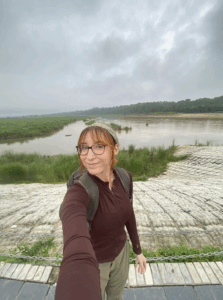
For the past three months, I’ve been living in the buffer zone of Chitwan National Park, a region often called the “Heart of the Jungle.” It’s a place where tigers, elephants, and rhinos are part of daily life not only inside the park, but also in the surrounding community.
My independent research focused on a deceptively simple question:
How do local communities perceive the effectiveness of solutions for preventing human-wildlife conflict?
On paper, the project looked clear: design a survey, collect data, analyze it.
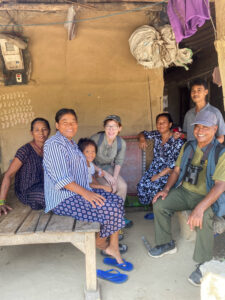
In practice, it meant knocking on strangers’ doors, navigating language barriers, biking down muddy roads, and listening more than I spoke. It meant sweating through long days in unfamiliar villages, sprinting through the wrath of the monsoon rains, sharing meals with new friends, and learning that not everything fits neatly into data points.
I spoke with over 100 people including farmers, students, elders, and local leaders whose lives have been shaped by living next to some of the world’s most powerful wildlife. Some told me about rhinos trampling their crops. Others described elephants decimating their homes. A few had even been injured themselves or lost loved ones. But by far the most common theme that came through was resilience and an unwavering desire for coexistence, not out of idealism, but out of necessity and care.
Of course, I couldn’t have done any of this without the National Trust for Nature Conservation (NTNC), a Nepali NGO doing incredible work in this space. Through their conservation education programs, skill-based trainings, and alternative income initiatives, I saw the kind of impact that goes beyond policy reports and headlines. I saw what it really means when conservation is rooted in community.
But this wasn’t the kind of trip that fits aesthetically into a instagram reel (despite the fact that I made quite a few these past few months). It was incredibly challenging.
Arriving in Nepal the day after my last final of the year at UC Berkeley, I went straight from my fast-paced, productivity-driven grindset of academia to a completely different life across the world. Here, life moves slowly, something I wasn’t used to and made me deeply uncomfortable in a way I never expected.
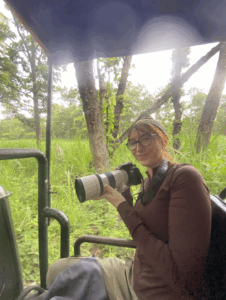
For the first time in a long time, I had no choice but to sit with myself. Connectivity is very spotty here, it is extremely common to lose power several times a day. So instead of filling the boring moments with endless scrolling, listening to music, or watching a show, I watched the sunrise in silence. I spent early mornings biking past water buffalo and taking pictures of the incredibly vibrant birds. I drank more tea than I ever have in my life.
And in those quiet, disconnected hours, I learned more about myself than I ever expected. I realized that the noisy, pressure-cooker environment I’d grown used to had left behind a lingering undercurrent of anxiety that didn’t disappear just because the noise stopped.
And yet, with time I felt something else:
I began to really trust myself.
No one was holding my hand. I had to make decisions, pivot plans, solve problems, and stay grounded even when I didn’t feel ready. I made mistakes. I learned fast. And I grew into someone capable of handling uncertainty without shutting down.
I came here to study conservation, but I left with a deeper understanding of people – their fears, their needs, their strength – and how tightly our lives are tied to the land we live on.
Nepal didn’t give me answers.
It gave me context.
It gave me contradictions.
It gave me humility.
And most of all – it gave me better questions.

To the entire NTNC team – and especially to Chiran Pokharel, Bob Dobias, Aashish Gurung, Raj Kumar, Surendra Chaudhary, Ram Kumar, and many others – thank you. Your guidance, generosity, and tireless commitment to conservation and community made this experience transformative.
Grae Wilder
Undergraduate Researcher | Wildlife Conservation Advocate | Always Learning
📍 Chitwan National Park, Nepal