Written from the safety of my room at UC Berkeley… reflecting on a wilder time.
From October – December 2025 I embarked on a trip to a place farther south than I’ve ever been before, COSTA RICA (not that far south I know – i still have much to explore)! I was able to do this as a program through my university’s study abroad and we explored locations like San Jose, Pitilla, Cuajiniquil, Monteverde, San Gerardo and Pueblo Antiguo.
I don’t exactly know how I am going to attempt to convey such a incredibly complex program in a single post, but wow was this a crazy social experiment.
I was entering this experience from a whole 5 months of traveling almost exclusively solo for my research project in Nepal and subsequent round-about hops home through southeast Asia and the west coast of the US. As I passed through passport control to Costa Rica, all I was thinking about was my nerves going into a room with people my age again. I was thinking “Do I even know how to talk to people anymore?” and was pushed directly into a space with around 30 University of California students all excited to start what we were sure would be a life-changing 3 months.
Luckily I was able to dust off my social skills and they came back to me relatively quickly as I was introducing myself to my new roomies!
Our journey kicked off in San Jose before we headed out on an epic 2 week field trip to different spots in Area de Conservación Guanacaste, eventually settling into the Estación Biologica in Monteverde. And eventually, we stayed at the Estación San Gerardo, nestled deep within the Bosque Eterno de los Niños.
We saw soooo much diversity it’s impossible to list here, probably hundreds, maybe even thousands of species in total!! My favorites were the spider monkeys, howler monkeys, and white-faced macaques, along with toucans, exotic reptiles, and even a mother and baby sloth! We ended the program with a much-needed soak at the Pueblo Antiguo hot springs before our final farewells in San Jose.
One of the highlights was definitely our agroecology field trips to local farms, which were just so cool to experience. We spent time at Finca Laguna Verde, a family-owned regenerative agriculture farm that has actually earned carbon-negative status. It’s a completely closed-loop system, they have everything from organic coffee and fruit to hogs, rabbits, and even fish. Seeing how they foster soil health and biodiversity by keeping forest patches as “live fences” was inspiring; it’s proof that farming doesn’t have to mean destroying the landscape.
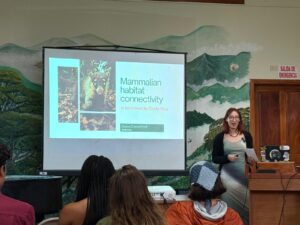
For my independent research, I spent a week playing wildlife detective with ten motion-triggered camera traps. I wanted to see how mammals move between that awesome regenerative farm and the Bajo del Tigre Reserve. I’ll admit, seeing domestic cats on my cameras at the farm (nine sightings!) was a bit of a “really, guys?” moment, but the wild results were incredible. I caught ocelots and margays exclusively in the reserve, and in the farm I saw a lot of armadillos and agoutis. I even caught a coyote and some coatis wandering through. It was meaningful to see that while the big cats still need the deep, protected forest, regenerative farms can act as vital corridors, allowing wildlife to forage and travel through human-used lands. Presenting these findings at our symposium was such a proud moment for me.
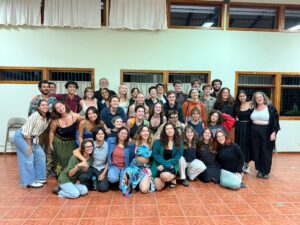
This experience was life-changing, and I have so many people to thank. To Frank Joyce and Federico Chinchilla, and to Eladio Cruz, Naomi, and Emi — thank you for your guidance, support, and for making this program what it was. And to the friends who made every long hike and rainy afternoon a blast: Emily, Haley, Antonella, Sophie, Noelle, Taryn, and everyone else, it was such a joy to meet you all. Costa Rica, you have my heart!